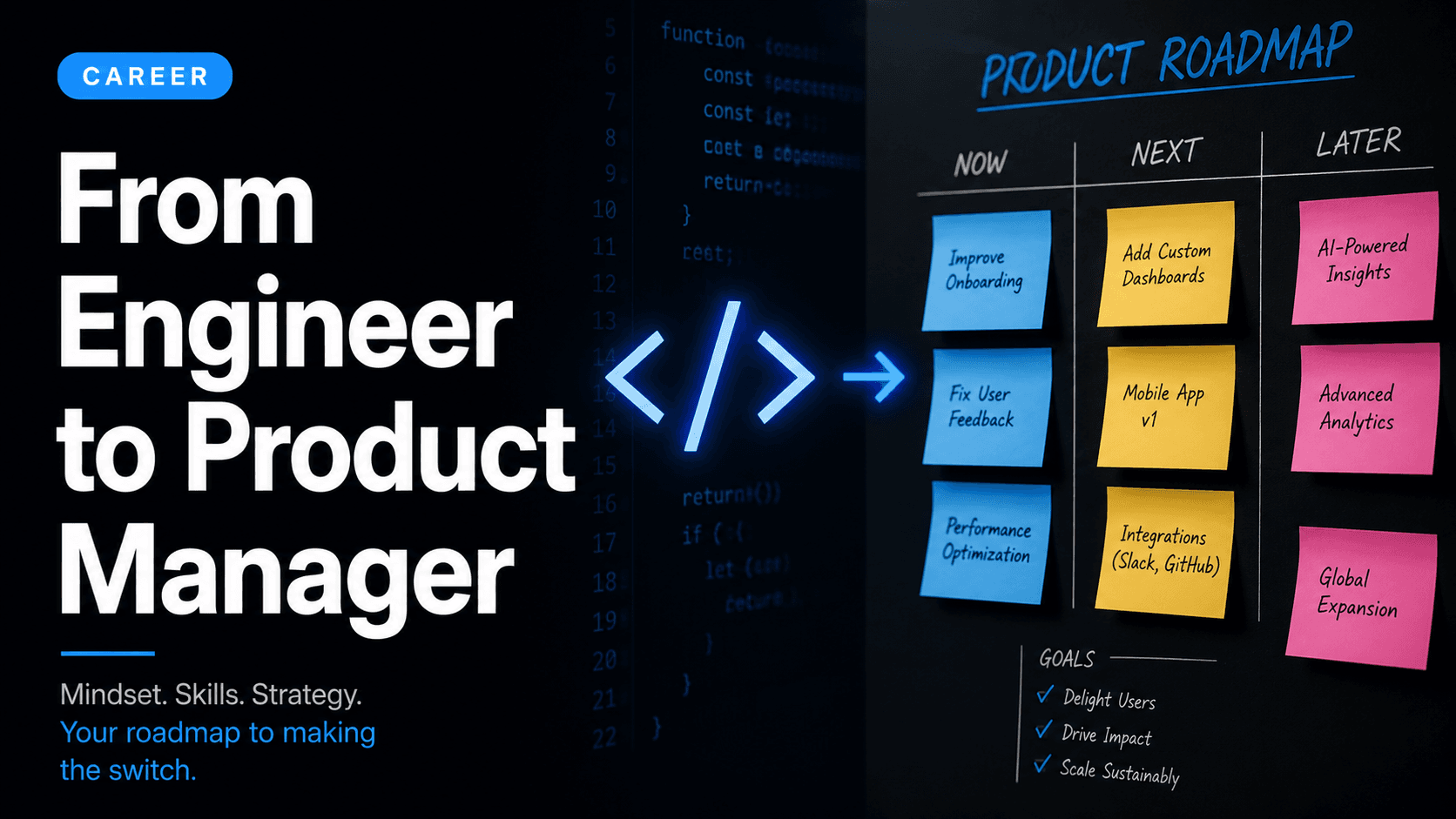
Making the switch from engineering to product is harder than most people expect and easier than others make it sound. Here's the real picture.
Engineers make some of the best product managers — and some of the worst. The technical background is a genuine advantage, but only if you're willing to completely change how you think about your job, how you measure success, and where your satisfaction comes from.
I made this transition five years ago, and I've watched dozens of engineers attempt it since. The ones who thrive share a set of realisations that usually come too late for the ones who struggle. This piece is an attempt to surface those realisations before you make the move.
What you're actually giving up
As an engineer, your work is tangible. You write code, it runs, you can see it do what you built it to do. The feedback loop is fast and concrete. You close your laptop at the end of the day knowing whether you accomplished something.
Product management doesn't work like that. Your job is to make decisions that will be validated or invalidated weeks or months later, by user behaviour that is ambiguous and multifactorial. You'll spend most of your day in meetings, writing documents, and having conversations. At the end of many days, you will genuinely not be sure whether you accomplished anything.
If your sense of professional satisfaction comes from building things, this transition will be harder than you expect. Product management is fundamentally about enabling others to build the right things. That's a different kind of satisfaction, and it takes time to develop a taste for it.
Your technical background is an advantage — used correctly
The engineering background is valuable in product management for specific reasons: you can have substantive conversations with engineers about feasibility and technical trade-offs, you can read the codebase when you need to understand something, you can spot when an estimate seems off, and you earn engineering trust faster than PMs without technical backgrounds.
What the engineering background is not is a substitute for the skills you actually need as a PM — user research, prioritisation frameworks, stakeholder management, clear writing, and the ability to make decisions with incomplete information.
The mistake many engineer-turned-PMs make is leaning on their technical credibility instead of developing these skills. They become the PM who always has a technical opinion but never talks to users. That's not a good PM — it's an engineer with a different job title.
How to make the transition without starting over
The most reliable path into product management for engineers is an internal move. Find a PM at your current company who is overloaded and offer to take on specific product responsibilities — writing a spec, running a customer discovery call, analysing usage data. Do it well. Make the PM's life easier. Build a track record.
This approach works because it gives you a portfolio of product work without leaving a role you're already good at. It also gives you a sponsor — the PM who can vouch for your contributions when a product role opens up internally.
If an internal move isn't available, the next best option is an APM programme at a larger company, or a product role at an early-stage startup where titles and roles are fluid. Both options may involve a step down in seniority, which is worth accepting in exchange for the chance to build a product track record.
The skills that matter most
User research is the skill most engineers undervalue when they move into product. Talking to customers feels soft and unscalable compared to looking at analytics data. But data tells you what is happening. Users tell you why. Without the why, you're optimising blind.
Written communication is the other skill that catches engineers off guard. Product management runs on documents — PRDs, strategy memos, decision summaries, stakeholder updates. If your writing is imprecise or assumes technical context that non-engineers don't have, you'll spend a disproportionate amount of time in clarifying conversations that could have been avoided.
Clear writing forces clear thinking. If you can't write a crisp one-pager explaining why a feature should be built, what problem it solves, and how you'll know if it worked — you probably don't have a clear enough view of the problem yet. Writing surfaces the gaps in your thinking before they become expensive mistakes in production.
What the first year actually looks like
The first year in product is usually humbling for engineers. You'll feel less competent than you did in your previous role. You'll be in meetings where you don't know what to say. You'll write a PRD and get feedback that it missed the point entirely. This is normal and it's not a sign you made the wrong choice.
The engineers who make the best product managers are the ones who treat this discomfort as data rather than a verdict. They stay curious, ask questions without embarrassment, and resist the urge to retreat to technical work where they feel more confident.
By the end of the first year, if you've been talking to users consistently, writing clearly, and staying close to your engineering team, you'll have built something that can't be faked: a genuine intuition for what your users need and what your team can build. That intuition is the core of the job. Everything else — the frameworks, the templates, the processes — is just scaffolding.