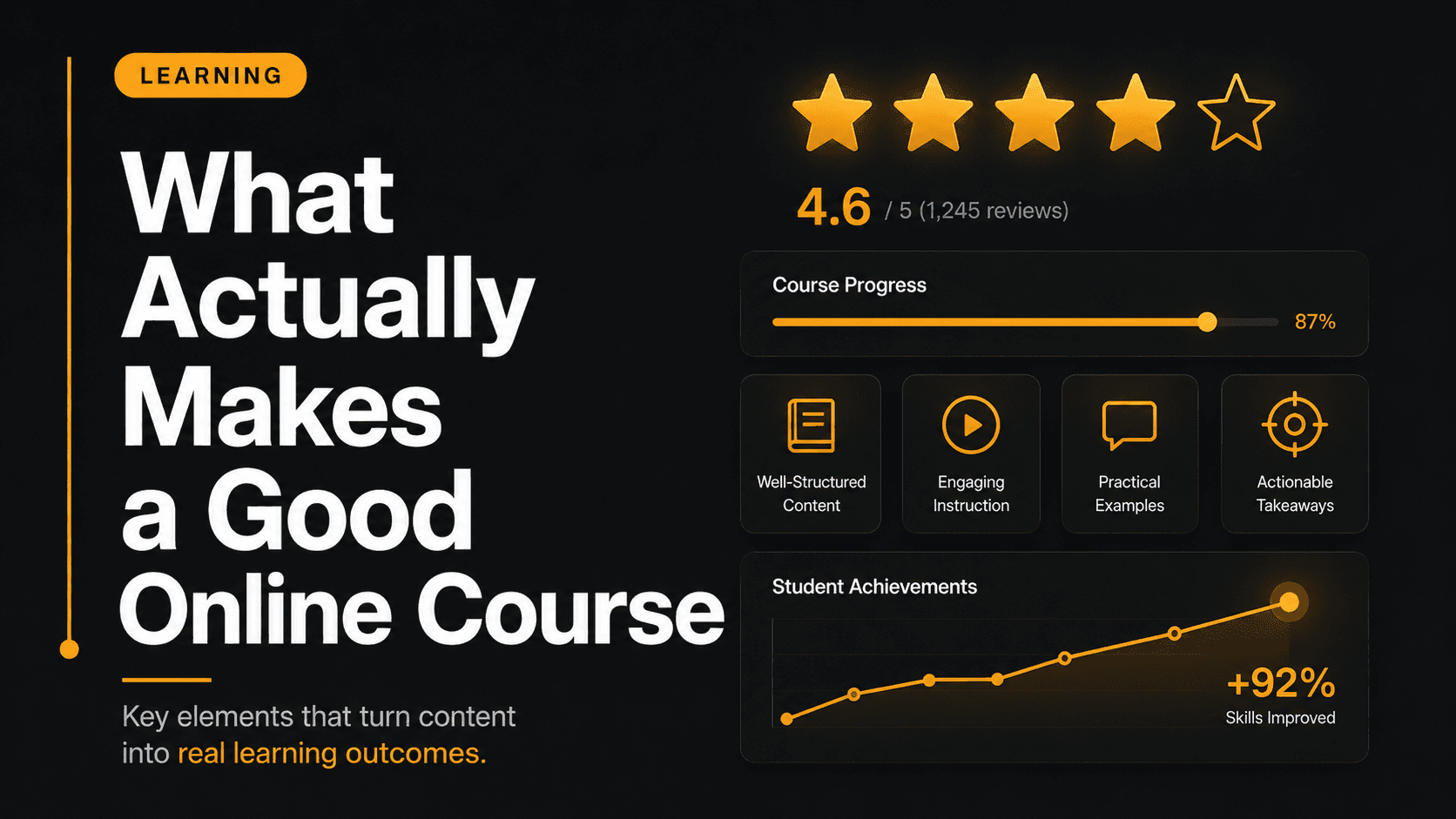
After reviewing hundreds of courses, the difference between a 4.2 and a 4.9 comes down to a few specific things.
Most online courses are bad. Not because the instructors don't know their subject — most of them do, often very well. They're bad because knowing something and being able to teach it are entirely different skills. The average online course is a knowledgeable person talking at a screen for 40 hours, with very little thought given to how a student actually learns.
But some courses are exceptional. They produce measurably better outcomes for students. They get 4.9 ratings not because of slick production or a famous instructor name, but because they're built around how learning actually works. Here's what those courses have in common.
They start with the outcome, not the content
The best courses begin with a precise answer to the question: 'What will a student be able to do when they finish this?' Not 'what will they know' — what will they be able to do. The distinction matters enormously. Courses built around knowledge transfer tend to be comprehensive but passive. Courses built around skill acquisition tend to be focused and practical.
When an instructor is clear about the outcome, every content decision becomes easier. Does this lesson move the student toward that outcome? If not, it probably shouldn't be in the course. The best courses are ruthlessly edited — not exhaustive.
They use projects, not just exercises
There's a meaningful difference between exercises and projects. Exercises test whether you understood the lesson. Projects require you to synthesise multiple concepts and apply them to something with a real purpose. Exercises are necessary. Projects are what create genuine skill.
The best courses integrate projects throughout, not just at the end. Each project should feel slightly beyond what the student has already covered — requiring them to stretch, look things up, make decisions. This productive difficulty is not a sign of a badly designed course. It's the mechanism of learning.
They respect the student's time
Long courses are not better courses. A 10-hour course that covers everything necessary is worth far more than a 40-hour course padded with repetition and tangents. The best instructors say what needs to be said and stop. They don't repeat themselves to fill time.
When you're evaluating a course before purchasing, look at the length and the curriculum structure together. Does the length seem proportional to what's being taught? Are the sections logically sequenced? If a 6-hour topic is stretched to 15 hours, that's a signal to keep looking.
The instructor explains their thinking, not just their actions
Screencast courses where an instructor types code or clicks through software while narrating what they're doing are often superficially engaging but leave students unable to reproduce what they watched. They saw the actions but not the reasoning.
The best instructors make their decision-making visible. They explain not just what they're doing, but why they're doing it that way and not another way. They acknowledge trade-offs. They point out common mistakes. They make the invisible visible, and that transparency is what transforms a demonstration into a lesson.
They build in retrieval practice
Retrieval practice — actively recalling information rather than passively reviewing it — is one of the most well-supported findings in learning science. Courses that include frequent, well-designed quizzes produce significantly better retention than courses without them.
Good quizzes test application, not just recall. They ask 'given this situation, what would you do?' rather than 'what is the definition of X?' The former requires understanding. The latter only requires short-term memory, and short-term memory is not a useful outcome.
How to evaluate a course before you buy
Watch the free preview lessons. Pay attention to how the instructor explains things, not just whether they seem knowledgeable. Do they anticipate your confusion? Do they explain why, not just what? Do they seem to care whether you understand, or are they just presenting information?
Read the negative reviews. They're more informative than the positive ones. Look for patterns — do multiple people mention the same problem? Complaints about pacing, outdated content, or a lack of practical application are red flags. Complaints about difficulty level are not — they often just reflect a mismatch between the student and the course.
Check when the course was last updated. In technical fields, a course that hasn't been touched in three years may be teaching tools or syntax that no longer represent best practice. In design, career development, or business skills, older material holds up considerably better.